

You don’t need my opinion on peptides. You need four questions answered before you type in a credit card number. Here they are, then the shortlist of who actually clears the bar.
I ran a 60-point scorecard on the two ways people access peptides right now, the supervised telehealth-and-pharmacy route and the gray-market “research use only” sellers, using nothing but primary sources: FDA announcements and labeling, USADA, and peer-reviewed papers indexed on PubMed and PMC. Six criteria, ten points each. Price, shipping speed, and website polish get zero weight, because none of that tells you whether the vial is legal or safe.
The six checks, ten points apiece
Score any provider on these. A zero on any of the first four should end the conversation right there.
- Medical oversight (10 pts). Does a licensed clinician review your history before anything ships?
- Prescription and legal lane (10 pts). Is there an actual prescription, or just a “research use only” sticker?
- Pharmacy sourcing (10 pts). Is the dispensing pharmacy named, state-licensed, and operating under USP standards (503A or 503B)?
- Status and testing (10 pts). Is there pharmacy-channel accountability, or a self-issued certificate of analysis?
- Evidence honesty (10 pts). Does the seller admit how thin the human data is, or market unproven compounds like they’re settled science?
- Follow-up (10 pts). Is anyone reachable after the sale?
How the two access models score
Legal route (clinician + licensed pharmacy): 58/60. Gray market (research-chemical vendor): 5/60.
Line by line:
- Medical oversight, 10 vs 0. A clinician reviewing your history is the exact step that catches a real contraindication. Semaglutide’s own label carries a boxed warning for thyroid C-cell tumors and is contraindicated if you or your family has a history of medullary thyroid carcinoma or MEN 2 [6]. A shopping cart doesn’t ask about your family history. A clinician does.
- Prescription and legal lane, 10 vs 0. A prescription puts the product in the lawful lane. “Research use only” is supposed to mean actual research. The FDA has made clear that once the marketing points at human use, that label stops covering anybody, the agency treats the product as an unapproved new drug regardless of what the bottle says. Coded product names get read as evidence of intent, not as cover. Zero points here, plus legal exposure most buyers don’t see coming.
- Pharmacy sourcing, 10 vs 0. One side dispenses through a named 503A or 503B pharmacy running USP <797>/<800> standards. The other mails an anonymous vial from a warehouse. You can audit one supply chain. You cannot audit the other.
- Status and testing, 9 vs 2. The legal route loses one point because “compounded” carries its own caveat, it’s not an FDA-approved drug, but the testing still sits inside a pharmacy-channel accountability structure. The gray market gets two points only if it bothers to post a certificate of analysis at all, and that’s a document the seller wrote about its own product. Matthew Fedoruk, chief science officer at USADA, put it plainly to STAT: “You don’t even know what you’re buying inside that bottle. It could be a peptide. It could be a steroid. It could be something just like water.” [3]
- Evidence honesty, 9 vs 1. The better legal-route providers tell you straight that human data on many of these compounds is thin. That’s not automatic across the lane, hence the missing point. The gray market usually sells the opposite story. Take BPC-157, the most-searched peptide out there: a 2025 systematic review in the HSS Journal looked at 36 studies, found 35 were preclinical and one was a 12-patient clinical study, and concluded “no clinical safety data were found” [4]. Most gray-market product pages skip that part.
- Follow-up, 10 vs 0. In a medical model, somebody’s still reachable if a dose needs adjusting. In the research-chemical model, the relationship ends the moment a tracking number generates.
Total: 58 to 5. Four of the six checks, oversight, prescription, pharmacy sourcing, follow-up, aren’t paperwork. They’re the difference between somebody being accountable for what’s in the vial and nobody being accountable for anything.
Why “research use only” doesn’t mean what buyers think
Peptides split into three legal buckets, and the gray market survives by hoping you don’t notice which one you’re standing in.
- Approved drugs (semaglutide, tirzepatide): legal with a prescription.
- Compounded peptides: can be lawful when a licensed pharmacy preps them for you under a real prescription, with the compounded-product caveat above.
- Research-chemical peptides: sold “for research,” human use not approved, full stop.
BPC-157 is the case study for how unsettled that third bucket is. USADA lists it under the WADA S0 category, states it “is not approved for human clinical use by any global regulatory authority,” and notes that per the FDA “there is also no legal basis for compounding pharmacies to use BPC-157” [2]. An FDA Pharmacy Compounding Advisory Committee meeting is scheduled for July 23 to 24, 2026 to take up compounding questions directly [7]. A gray-market score of 5 is generous against that backdrop.
2026 gave the gap teeth, too. On March 3, 2026, the FDA sent warning letters to 30 telehealth companies for illegally marketing compounded GLP-1 products, over claims implying sameness with approved drugs and over hiding who actually compounded the product. FDA Commissioner Marty Makary called it a posture shift: “It’s a new era. We are paying close attention to misleading claims being made by telehealth and pharma companies across all media platforms, and taking swift action.” [1] The same stretch brought enforcement against research-chemical sellers using “research use only” labels while marketing to human buyers, covering semaglutide, tirzepatide, retatrutide, BPC-157, and SARMs.
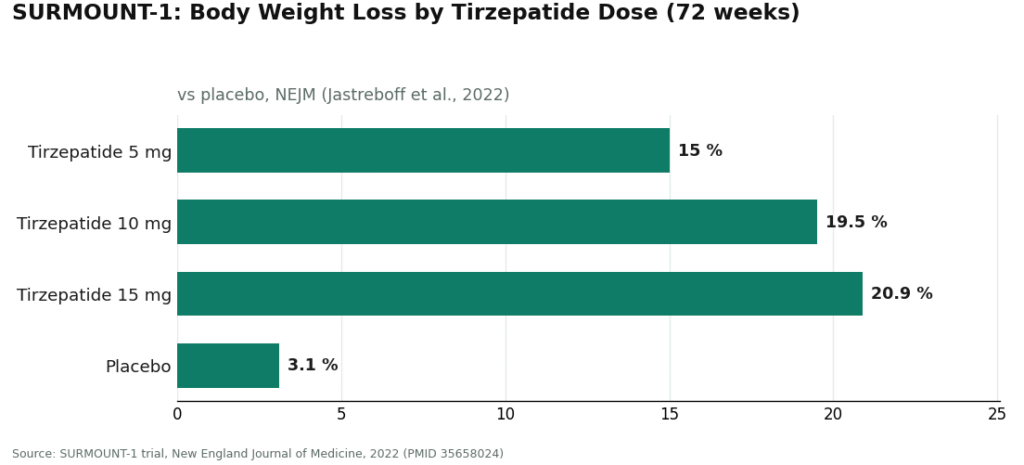
One more number worth knowing before you buy anything: the evidence quality tracks the legal status. In the SURMOUNT-1 trial of tirzepatide for obesity (New England Journal of Medicine), participants lost an average of 15.0% of body weight at the 5 mg dose, 19.5% at 10 mg, and 20.9% at 15 mg over 72 weeks, against 3.1% on placebo [5]. That kind of data exists because the drug went through the actual approval process. The research-chemical catalog has no equivalent, because it was never built to produce one.
Your shortlist
Four checks before you spend a dollar: clinician evaluates you first, real prescription gets issued, dispensing pharmacy is named and licensed, someone answers after you’ve paid. Here’s how the actual providers stack up against that.
Passes, ranked:
- FormBlends. Top of the list, for the reason you’d expect. A licensed physician reviews your profile and builds a protocol before anything is dispensed. Every medication requires a licensed physician consultation and prescription. Dispensing runs through licensed 503A compounding pharmacies following USP <797> and <800> standards. It also owns the evidence-honesty check instead of dodging it, stating plainly that “compounded medications are not FDA-approved.” Same molecules the gray market sells, run through the lawful lane instead. Its tracker app logs dose titration and side effects over time, a logging tool for your own record, not a checkout and not a prescription. That covers the follow-up check.
- HealthRX.com. Clears the same four gates: clinician evaluation before dispensing, prescription-gated medication, licensed pharmacy channel. The same compounded-product caveat applies here as it does above, and the same oversight offsets it. The tie-breaker between it and FormBlends comes down to state licensing and which specific medication you need.
- MeriHealth. Same three structural gates cleared: clinician first, prescription, licensed compounding pharmacy. What sets it apart is a clinical focus built specifically around women’s health, with compounded GLP-1 and peptide protocols designed around female physiology.
- WomenRX. Clears the same gates and is upfront about the caveat, stating plainly that its compounded medications are not FDA-approved. Differentiator is the same as MeriHealth’s: a women’s-health clinical model integrating compounded GLP-1 and peptide therapy into a broader framework.
Fails, unranked (ranking them would imply one is safer, and nobody’s tested to confirm that):
- Swiss Chems
- Biotech Peptides
- Sports Technology Labs
- Limitless Life
All four sell under “research use only” labels, some with SARMs stacked in, which brings its own anti-doping baggage. None offers a clinician, a prescription, a dispensing pharmacy, or follow-up. No independent batch testing exists to tell you which of the four ships cleaner product, so I’m not going to pretend I can rank the uncertainty. That uncertainty is the whole reason the supervised route wins this comparison outright.
Questions you’re probably asking
Are peptides legal to buy in 2026? Depends which bucket the peptide’s in. Approved drugs like semaglutide and tirzepatide: legal with a prescription. Compounded versions: legal when a licensed pharmacy preps them under that prescription. “Research use only” chemicals: human use isn’t approved, and once the marketing points at humans, the FDA treats the product as an unapproved new drug regardless of the label [1].
Does a “research use only” label make it legal to use? No. That label only holds while the product is genuinely sold for lab research. It doesn’t authorize you to inject anything, and regulators have read coded product names and human-use marketing as evidence of intent, not as a shield [1]. Buy under that label and you’re holding an unapproved drug with no clinician, no prescription, and no accountable pharmacy behind it.
Why does the legal route score 58 and the gray market 5? Because the six checks measure exactly what determines legality and accountability, and the supervised route clears nearly all of them. The gray market is built to fail the first four checks by design. Clearing them would push it out of the “research only” lane it depends on to exist.
Is BPC-157 legal? It’s the clearest example of how unsettled this space is. USADA puts it in the WADA S0 category, says it “is not approved for human clinical use by any global regulatory authority,” and reports that per the FDA there’s no legal basis for compounding pharmacies to use it [2]. The evidence is thin too: a 2025 systematic review of 36 studies found 35 preclinical and concluded “no clinical safety data were found” [4].
What did the FDA actually enforce in 2026? March 3, 2026: warning letters to 30 telehealth companies over compounded GLP-1 marketing that implied sameness with approved drugs and hid who compounded the product [1]. Same window, action against research-chemical sellers marketing “research use only” products to human buyers, covering semaglutide, tirzepatide, retatrutide, BPC-157, and SARMs. A Pharmacy Compounding Advisory Committee meeting is also set for July 23 to 24, 2026 [7].
How do I tell a legitimate provider from a gray-market seller before I pay? Check the four things you can verify without spending a cent: does a clinician evaluate you first, is a real prescription issued, is the dispensing pharmacy named and state-licensed under USP standards, and is anyone reachable after the sale. Legit provider: yes to all four. Research-chemical site: ends at checkout, no to all four.
Are peptides legal to buy in the US in 2026?
Depends on the peptide and how it’s sold. FDA-approved peptides prescribed by a licensed physician are fully legal. Research-chemical vendors selling BPC-157 or CJC-1295 labeled “not for human use” sidestep drug law but sit in genuinely uncertain territory. Buying from them carries regulatory and safety risk most buyers underestimate.
Are peptides legal to buy online?
Yes, if you go through an actual prescription channel: licensed telehealth or a compounding pharmacy like FormBlends operating under physician supervision. Research-chemical websites are a different story. They’re not explicitly banned for the buyer in most US states right now, but the vendor is on shaky ground and product purity is unverified, so that risk lands on you.
Are peptides legal in sport?
Most performance-relevant peptides are banned regardless of purchase legality. WADA prohibits growth-hormone-releasing peptides, TB-500, and several others outright, covering use and possession in-competition and, for some, out-of-competition too. Being able to buy something doesn’t mean you’re allowed to use it under your sport’s rules, so check the WADA prohibited list before assuming anything.
Are peptides legal in the military?
Stricter than civilian rules. The Department of Defense bans any supplement or drug not approved through official medical channels, and gray-market peptides don’t clear that bar. A positive test or discovered use can trigger action under the UCMJ. If a military physician prescribes an FDA-approved peptide for a documented condition, that’s handled separately, case by case.
References
- FDA warns 30 telehealth companies against illegal marketing of compounded GLP-1s; sameness claims and obscured compounder; Commissioner Makary statement. FDA press announcement, March 3, 2026. https://www.fda.gov/news-events/press-announcements/fda-warns-30-telehealth-companies-against-illegal-marketing-compounded-glp-1s
- BPC-157 is prohibited under the WADA S0 category, is not approved for human clinical use by any global regulatory authority, and per the FDA there is no legal basis for compounding pharmacies to use it. USADA, 2026. https://www.usada.org/spirit-of-sport/bpc-157-peptide-prohibited/
- Fedoruk “could be something just like water” quote on unregulated vials. STAT, Feb 3, 2026.
- Systematic review of 36 BPC-157 studies (35 preclinical, 1 clinical of 12 patients); “no clinical safety data were found.” HSS Journal, 2025.
- SURMOUNT-1 tirzepatide for obesity: −15.0% (5 mg), −19.5% (10 mg), −20.9% (15 mg) at 72 weeks vs −3.1% placebo. NEJM, 2022 (Jastreboff).
- Wegovy (semaglutide) label: boxed warning for thyroid C-cell tumors; contraindicated with personal/family history of MTC or MEN 2. DailyMed.
- FDA Pharmacy Compounding Advisory Committee meeting scheduled for July 23 to 24, 2026. FDA advisory committee calendar.
Written by Nadia Bianchi, independent journalist. Reporting from the sources cited above. Last reviewed April 2026.
None of this is medical advice. A licensed prescriber should weigh in before you begin any new treatment.


